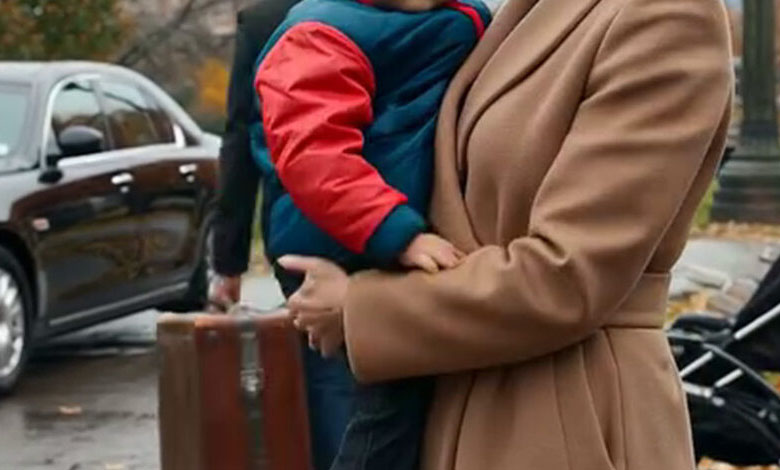
I saw my son on a bench in the park, sitting there with his baby beside a pile of suitcases.
I asked, “Why are you here and not at the office of my company—the one I entrusted to you?”
He lowered his head. “I was fired. My father-in-law said our blood doesn’t match his. Said I’m bad for the brand.”
I chuckled. “Get in the car, baby.”
He didn’t even know who had actually been paying his father-in-law’s salary all these years.
Please subscribe to our channel and write in the comments which state or city you are listening from. Enjoy the story.
Chicago looks deceptively calm from the height of the 25th floor. Gray rooftops, the steel-cold Chicago River, endless streams of cars looking like ants carrying their burdens.
I stood by the tinted window of my office holding a cup of cold tea, watching the movement. To some, it is just city traffic. To me, it is the circulatory system of my business.
Vance Logistics, a name that might not mean much to the average person on the street, but one that opens any door in ports from New York to Los Angeles. I built this empire for 30 years.
I started with one used truck and debts that would make other people put a noose around their necks. I learned to be tough when needed and invisible when it was profitable.
Especially invisible.
Money likes silence, and big money loves dead silence. That is why you won’t find my photo in the society pages.
I always preferred to stay in the shadows pulling the strings while others strutted on stage. That was my strategy, and it worked flawlessly until recently.
My gaze fell on the family photo framed on my desk. Marcus—my son, my only weakness, and my greatest investment.
Three years ago, I took a step that many of my partners would have called risky. I decided to test him.
Not the kind of test where rich kids sit in their father’s offices pretending to work. No, I wanted Marcus to go through the real school of life.
I bought a midsized company, a logistics firm called Midwest Cargo, and I put someone else in charge.
No, not my son.
I put Preston Galloway there.
He was the father of my son’s wife, a man whose ego was inflated far more than his bank account.
Preston Galloway.
I smirked at my reflection in the glass. The man was a walking caricature of high society.
He loved to talk about old money, about heritage, about how business is an art accessible only to the chosen few.
He didn’t know one thing.
Midwest Cargo belongs to me.
Through a chain of offshore accounts and proxies, the ultimate beneficiary of everything he was so proud of was me—the Black woman he called a simple traitor behind my back.
I sent Marcus to work for him as the commercial director without any protection, without my direct interference.
“Mama, I can handle it,” Marcus told me back then. “I want Tiffany and her father to respect me for my own merit, not for your checkbook.”
I agreed.
I wanted him to learn how to take a hit, to see the ugly side of people when they think they have power over you.
And he saw it.
Oh, how he saw it.
Every Sunday I drove to their mansion in Lake Forest for dinner. This house with its columns and manicured lawns was the embodiment of the Galloways’ ambition.
The irony was that the mortgage for this house was indirectly paid from the dividends of my own company, but I stayed silent.
I sat at the table carefully cutting my roast beef and listened.
“Marcus, who holds a glass like that?” Preston would grimace, adjusting his napkin. “This is a vintage Cabernet, not malt liquor from the corner store.”
“You still have so much to learn about etiquette,” he’d go on. “In our circle, such small details betray one’s breeding—or lack thereof.”
Tiffany, my daughter-in-law, would just smile coldly, stroking the diamond bracelet on her thin wrist.
She never defended her husband. On the contrary, she enjoyed the humiliation.
She looked at Marcus like a useful but slightly defective accessory.
“Daddy just wants what’s best for you, honey,” she would say in her slow, sugary voice. “You should be grateful he took you under his wing.”
“Where would you be without our family?”
I drank my tea and recorded every word, every smirk. I saw my son’s fists clenching under the table.
I saw the light fading in his eyes, but I waited.
I gave him my word not to interfere until he asked.
That was the deal.
But in recent months, my intuition—that beast that saved me back in the ’90s—started to growl low in my throat.
Something had changed.
The air became thick.
At first, it was little things.
Reports from Midwest Cargo started arriving with delays. Not a day or two, which is acceptable, but a week.
In logistics, a week is an eternity.
Preston explained it as a software update and staff optimization. But I know this business from the inside out.
When a director starts talking about optimization, it means he is trying to hide holes in the budget.
Then Tiffany stopped answering my calls.
Before, she at least pretended to be polite, hoping for expensive gifts for the holidays. Now—silence.
“We are at a reception.”
“We have a charity evening.”
“Tiffany is resting.”
It was like a wall had gone up.
But the final straw that made me truly alert was Marcus.
He came to see me a week ago just for half an hour. He looked terrible.
Gray complexion, hollow cheeks, nervous hand movements.
He said everything was fine, just a lot of work closing the quarter.
But I wasn’t looking at his face.
I was looking at his wrist.
There was no watch on his arm.
The Patek Philippe I gave him for his 30th birthday. A status piece, expensive but mostly memorable.
He never took it off.
“Where is the watch, son?” I asked, pouring him coffee.
He flinched and pulled down his shirt cuff.
“At the repair shop, Mama,” he said. “The clasp was acting up. Decided to get it cleaned while I was at it.”
A lie.
I heard it not in his voice, but in the pause he took before answering.
Marcus never had a clasp act up, and he never lied to me so clumsily.
The watch wasn’t in repair.
It was either sold or pawned.
Why would the commercial director of a successful firm pawn a watch?
The answer could only be one.
He urgently needed money.
Money he couldn’t ask me for.
After he left, I didn’t call him or Preston.
I called Luther, my head of security.
“I need a full audit of Midwest Cargo,” I said dryly. “And find out what is happening in the Galloway house—unofficially. Just watch.”