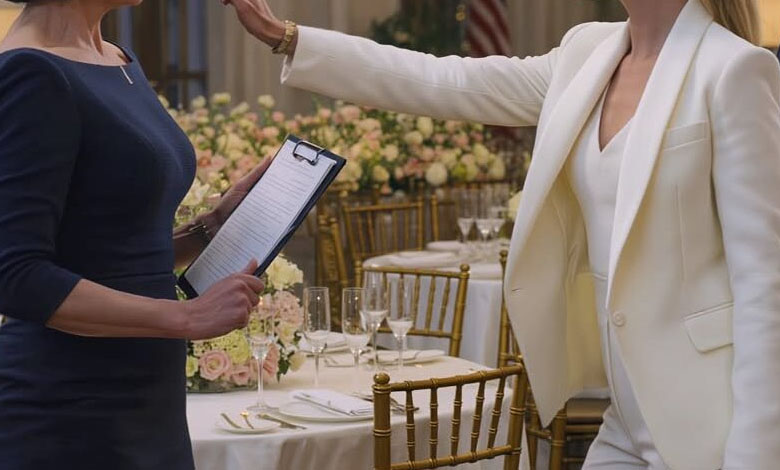
“You want to give me a present? Get out of my life. You’re the worst mother anyone could ever have.”
The words hung in the air of the elegant country club dining room, sharp as glass shards and just as cutting. For a moment, everything around me seemed to freeze—the waitstaff pouring champagne, the wedding planner reviewing tomorrow’s timeline, the curious glances from Blake’s parents.
I, Sophia Carter, fifty-eight years old, stood perfectly still, my hands still outstretched toward the seating chart I’d been trying to discuss with my daughter.
“Amber,” I said quietly. “Let’s step outside and talk about this calmly.”
“There’s nothing to talk about,” Amber hissed, her perfectly made-up face contorted with a rage that felt wildly disproportionate to my simple suggestion about moving her fragile grandmother to a table farther from the band.
“You always do this,” she went on. “Try to control everything. Embarrass me in front of everyone.”
“I was just thinking of Grandma Helen’s hearing aids,” I began.
“Stop. Just stop.”
Amber’s voice rose, drawing more attention from the wedding party gathered for the rehearsal dinner. “This is my wedding. Mine. Not yours. Not Grandma’s. I’ve worked too hard to have everything perfect.”
Blake, my soon-to-be son-in-law, shifted uncomfortably beside her, but he remained silent. His parents exchanged glances that managed to convey both embarrassment and a certain smug validation, as if Amber’s outburst confirmed everything they’d suspected about her upbringing.
“Amber, sweetheart,” I tried again, aware of the growing audience. “I only want what’s best for everyone tomorrow.”
“‘What’s best’?” She laughed, a brittle sound devoid of humor. “What’s best would be if you disappeared.”
Then she leaned in, and her voice sharpened like a blade.
“Seriously, Mom. If you really want to give me a wedding present, just disappear from my life. I’m sick of apologizing for you to Blake’s family.”
The room went silent. Even the waitstaff froze in place.
Blake’s mother, Victoria, pressed her expensive linen napkin to her lips, her eyes gleaming with something that might have been pity but looked a lot like satisfaction.
“Amber,” Blake finally murmured, touching her arm gently. “Maybe we should—”
“No, Blake. I’m done pretending.”
Amber shook off his hand, her diamond engagement ring catching the light. “Do you know what Victoria asked me yesterday? She asked if my mother would be comfortable at the country club… or if she’d feel out of place, like I’m some kind of charity case you’re including out of obligation.”
I absorbed that with a strange detachment. After three decades of single motherhood—double shifts and deferred dreams, scrimping and saving to provide dance lessons and SAT tutors and law school tuition—I was being discussed as an embarrassment to be tolerated.
“I see,” I said, my voice steadier than I felt. “And what did you tell Victoria?”
Amber’s silence answered more eloquently than words.
“Amber has been very gracious about including everyone,” Victoria interjected smoothly, her country club poise unshakable. “We simply want tomorrow to go perfectly for both families.”
Both families.
As if my family—just me, really, and elderly Grandma Helen—were somehow comparable to the Prescotts, with their old money and legacy admissions to Ivy League schools.
“It will be perfect,” I assured her, with a smile that cost me everything to produce. “Now, if you’ll excuse me, I think I need some air.”
I walked out of the dining room with my back straight and my head high, feeling the weight of their stares. Only once I reached the empty ladies’ lounge did I allow myself to sink onto a velvet chair, my hands shaking as the full impact of my daughter’s words hit me.
You’re the worst mother anyone could have.
Was I?
I stared at my reflection in the ornate mirror. A woman with silver-streaked dark hair cut in a practical bob, wearing a department-store dress I’d spent hours selecting. Not glamorous like Victoria Prescott with her salon-maintained blonde perfection—but not the embarrassment Amber had portrayed, either.
I thought back over the years: Halloween costumes sewn late into the night, school lunches packed with handwritten notes, college care packages, quiet support through Amber’s first heartbreak. I’d made mistakes—certainly, all parents do—but the worst mother anyone could have?
My phone buzzed with a text from Amber.
Where did you go? The planner needs to go over your entrance timing again.
No apology. No acknowledgement of the cruel words still reverberating in my head. Just impatience that I wasn’t fulfilling my assigned role in her perfect production.
I texted back, Not feeling well. Going home to rest before tomorrow. Everything will be fine.
As I drove home to the modest three-bedroom house where I’d raised Amber alone after her father decided fatherhood was too constraining for his lifestyle, I found myself thinking about the property across town where Amber and Blake now lived.
The beautiful colonial on Maple Avenue that had belonged to my father, passed to me upon his death three years ago, with the suggestion—never a condition—that I could transfer it to Amber when the time was right.
I’d allowed them to move in immediately, planning to sign over the deed as a wedding gift, a fresh start without the burden of a mortgage. Amber had never questioned the arrangement. She’d never asked about the property’s ownership.
She’d simply accepted, the way she’d always accepted my sacrifices—with an entitlement I’d mistaken for confidence.
At home, I kicked off my sensible heels and sat at my kitchen table, surrounded by wedding preparations. My mother-of-the-bride dress hung on the laundry-room door, soft blue silk I’d saved for months to afford.
The handcrafted guest book I’d spent weeks creating. The emergency kit of fashion tape and aspirin and Band-Aids I’d assembled for tomorrow.
“Desaparece de mi vida,” I whispered to the empty room, testing how the words felt in my mouth.
Disappear from my life.
Perhaps after all these years, it was time to give my daughter exactly what she’d asked for.
I reached for my laptop, opened it, and began to type.
Morning light filtering through my bedroom curtains found me already awake, my eyes gritty from a night spent alternating between tears and methodical planning.
My phone displayed seventeen missed calls and twenty-three text messages—most from Amber, growing increasingly frantic as the night progressed.
Mom, the planner needs to confirm your hair appointment time.
Mom, are you seriously not answering?
The rehearsal isn’t even over.
Mother, this is ridiculous. Call me now.
And finally, sent at 2:17 a.m.
Fine, be that way. But you better be at the venue by 10:00 a.m. tomorrow, or I swear to God, I will never forgive you.
I set the phone aside and walked to my closet, pushing past the garment bag containing my mother-of-the-bride dress. Instead, I pulled out practical clothes—jeans, a comfortable sweater, slip-on shoes.
Today would require mobility, not ceremony.
At my small kitchen table, I reviewed the documents I’d spent the night gathering: property deeds, bank statements, contracts with wedding vendors, and years of financial records meticulously organized in my old-fashioned filing cabinet.
The paper trail of maternal sacrifice laid bare in black and white.
My father had been an accountant. He taught me the importance of documentation.
“People can argue with your words,” he’d say, “but they can’t argue with numbers.”
How right he’d been.
I made my first call at precisely seven a.m. to Jonathan Mills, my father’s attorney and the executor of his will.
“Sophia? Everything all right? Isn’t today the big wedding?” His familiar voice carried concern.
“There’s been a change of plans, Jonathan. I need to discuss the property on Maple Avenue, the one currently occupied by my daughter and her fiancé.”
“Your father’s house? I thought you were planning to transfer ownership to Amber as a wedding gift.”
“Plans change,” I replied, my voice calmer than I felt. “I’d like to explore my options for selling the property.”
A pause.
“Sophia… is everything okay? This seems sudden.”
“I’ve had a revelation,” I said, “about respect, boundaries, and the true nature of gift-giving.” I glanced at the property deed before me. “The house is still legally in my name, correct?”
“Yes. Absolutely. Your father left it to you without conditions. His suggestion about transferring it to Amber was just that—a suggestion. Legally, you’re free to sell it if you wish.”
“And what would be the fastest possible timeline for such a sale?”
Jonathan coughed slightly. “Well, in today’s market, with a desirable property like that… if you’re willing to accept a slightly below-market offer, I know several investors who purchase with cash and minimal contingencies. We could potentially close in as little as forty-eight hours.”
“Perfect. Please make the calls. I’ll come to your office at noon to sign whatever’s necessary.”
My next call was to Margaret Willis, the wedding planner Amber had selected for her dream wedding—a woman whose services I was paying for despite Amber allowing Blake’s family to believe they were contributing significantly.
“Mrs. Carter, I was just about to call you. We missed you at the end of the rehearsal last night, and there are a few details—”
“Margaret,” I interrupted gently. “I’m afraid there’s been a significant change. I need you to contact all vendors and cancel today’s event.”
Silence, then a sputtering response.
“Cancel? Mrs. Carter, the wedding is in six hours. That’s not— We can’t possibly—”
“Check your contract, Margaret. Section seven, paragraph three specifies that as the financially responsible party, I retain the right to cancel with compensation for the vendor’s time and materials. I understand there will be substantial cancellation fees. I’m prepared to pay them all.”
“But… but the bride—”
“Miss Carter will be devastated.”
“I’m sure she will,” I agreed, remembering the venom in Amber’s voice. “Nevertheless, please proceed with the cancellations. All of them. Venue, catering, flowers, music, photography—everything.”
After ending the call with the thoroughly flustered wedding planner, I moved systematically through my list.
The caterer. The florist. The string quartet. The photographer.
With each call, I calmly identified myself as the contracting party, referenced the relevant cancellation clause, and authorized whatever payments were necessary to compensate for the last-minute change.
By 9:30 a.m., I had dismantled every aspect of the seventy-five-thousand-dollar wedding I’d spent two years saving for.
My retirement account was significantly lighter. But a strange sense of peace had settled over me.
My phone continued to buzz with incoming calls—Amber, the wedding planner, even Blake once—but I let them all go to voicemail as I packed an overnight bag and gathered the documents I’d organized overnight.
The final item on my morning’s agenda was perhaps the most difficult. I called my elderly mother, who had been so looking forward to seeing her only granddaughter walk down the aisle.
“Mom,” I said when she answered, “there’s been a change of plans with the wedding.”
“What’s happened, Sophia? Is Amber all right?”
“Amber is physically fine,” I assured her. “But the wedding won’t be happening today. I’ll explain everything later. For now, I need you to trust me.”
A pause, then my mother’s voice, softer but certain.
“I’ve always trusted you, Sophia. You’re the most reliable person I know.”
Her simple faith nearly broke my composure.
“Thank you, Mom. That means more than you know right now.”
As I ended the call, my doorbell rang with an insistence that could only belong to one person.
I took a deep breath, straightened my shoulders, and opened the door to face my daughter.
Amber stood on my porch in designer yoga pants and an expensive sweatshirt, her face flushed with anger and her eyes wild with panic.
“Mom, what the hell? I’ve been calling you all night. The hair and makeup people are already at the venue, and Margaret says she can’t reach you—”
She stopped abruptly, taking in my casual clothes and the packed bag visible in the hallway behind me.
“Why aren’t you dressed? We need to leave for the venue in like an hour.”
I studied my daughter’s face—the face I’d memorized as a newborn, kissed better after countless childhood injuries, watched mature into beautiful adulthood.
The same face that had twisted with contempt just hours ago as she publicly rejected twenty-eight years of maternal devotion.
“There’s been a change of plans, Amber,” I said quietly.
“The wedding has been canceled.”
Her expression froze, then transformed into something between horror and rage.
“What are you talking about? Canceled? That’s not— You can’t.”
She pushed past me into the house, already pulling out her phone.
“I need to call Margaret right now and fix whatever miscommunication—”
“It’s not a miscommunication,” I interrupted, closing the door behind her. “I called every vendor this morning and canceled their services. The venue, the catering, the flowers—all of it.”
Amber turned to me slowly, her face draining of color.
“You… what?”
“You can’t do that. It’s my wedding.”
“Actually, I can,” I said, “and I did. Every contract was in my name, with my signature, paid for with my money.”
“I don’t understand,” she whispered, her voice suddenly small. “Why would you do this to me?”
I met her gaze steadily.
“Last night, you made a request. You asked me to give you a gift—to disappear from your life. You called me the worst mother anyone could have.”
The words still stung, but my voice remained even.
“I’ve decided to honor your request. This is the first step.”
Amber’s phone began to ring—Blake’s ringtone. She answered it with trembling hands.
“Blake, something’s wrong. My mother says she canceled the wedding. I don’t understand what’s happening.”
His voice was tiny through the speaker, equally confused and increasingly alarmed.
I gestured for Amber to follow me into the kitchen, where I’d laid out the documentation of my overnight work.
“I need to go,” Amber told Blake abruptly. “Come to my mom’s house now.”
She ended the call and stared at the papers spread across my kitchen table.
“What is all this?”
“This,” I said, picking up the first folder, “is the truth about your perfect life.”
“What are you talking about? What truth?” Amber’s voice wavered between anger and fear as she stared at the array of documents.
“Please sit down,” I said, gesturing to a chair.
For once, Amber complied without argument—perhaps too stunned by the cancellation bombshell to resist.
I selected the first folder labeled Wedding and opened it.
“This contains every contract, deposit slip, and payment confirmation for the wedding that won’t be happening today.” I tapped the summary page. “Total expenditure: $78,452.36. All paid from my accounts.”
Amber’s eyes widened.
“But… Blake’s parents contributed—
“Nothing,” I finished for her. “Despite what you led them to believe.”
A flush crept up her neck.
“I never said they were paying. They just assumed, and it was easier to let them think that—”
“That I couldn’t afford to give my daughter a proper wedding,” I supplied. “That you were graciously including your embarrassing mother, despite the financial burden it placed on you and Blake’s family.”
The direct hit landed. Amber’s flush deepened.
“It wasn’t like that.”
“It was exactly like that, Amber.”
I pulled out a specific document—an email from Victoria Prescott to the country club’s event coordinator that Amber had accidentally forwarded to me months ago.
“Your future mother-in-law specifically mentioned how kind Blake was to subsidize such an extravagant affair when the bride’s family clearly couldn’t manage it.”
Amber’s eyes skittered away from mine.
“Victoria is just… she says things sometimes. It doesn’t mean anything.”
“And you never corrected her.”
It wasn’t a question.
“You allowed Blake’s family to believe I was some struggling, unsophisticated burden you were tolerating out of obligation.”
“Mom, you’re overreacting.” Amber’s voice rose, desperate. “The wedding is in a few hours. We can talk about this later.”
“There is no wedding, Amber. Not today.”
I closed the Wedding folder and opened the next one labeled Education.
“What is all this?” Amber demanded. “Some kind of weird scrapbook of financial martyrdom?”
“Documentation,” I corrected calmly. “Something your grandfather taught me the value of long ago.”
I removed a stack of tuition receipts, loan documents, and bank transfers.
“Your education. Private elementary school, when the public school in our district was underperforming: $124,000. SAT tutoring and college application coaching: $8,700. Undergraduate degree at Northeastern: $183,000. Law school at Boston University: $213,550.”
I placed another document on top—a loan satisfaction letter.
“The student loans you think Blake’s father secretly paid off as a graduation gift?” I tapped the letter. “That was me liquidating the investment account I maintained since before you were born.”
Amber stared at the papers, her expression shifting from defiance to confusion.
“But Mr. Prescott said he told Blake he—”
“He lied, apparently,” I said. “Or perhaps Blake lied to you. Either way, I’m the one who ensured you graduated debt-free—not the Prescotts.”
I didn’t raise my voice. I didn’t need to.
“The important thing isn’t who paid, Amber. It’s that you never once questioned it. You simply accepted that someone had magically solved your financial problem without ever considering it might have been your embarrassing mother.”
The doorbell rang, sharp and insistent. Blake, undoubtedly.
“Don’t answer it yet,” I said, opening the third—and most significant—folder. “There’s one more thing we need to discuss before Blake joins us.”
“What now?” Amber asked, her voice smaller than before. “More evidence of what a terrible daughter I am?”
“No,” I replied, sliding the property deed across the table. “Evidence of what you’re about to lose.”
Amber glanced at the document, her brow furrowing.
“The house deed? Why are you showing me this?”
“Look at the owner’s name, Amber.”
She scanned the document, then looked up, genuine confusion in her eyes.
“I don’t understand. Why is your name on our house deed?”
“Because it’s not your house,” I said gently. “It never was.”
I kept my voice soft despite the gravity of what I was revealing.
“The house on Maple Avenue belonged to your grandfather. When he died three years ago, he left it to me.”
The doorbell rang again, followed by knocking.
Amber barely seemed to notice, her attention fixed on the deed in her trembling hands.
“But we’ve been living there since before we got engaged. You said it was my inheritance.”
“I said it was part of your grandfather’s legacy that would eventually come to you,” I corrected. “I allowed you and Blake to move in, thinking I would transfer ownership as a wedding gift.”
“I never charged you rent. Never asked for contributions toward the property taxes or insurance I’ve been paying.”
“So… the house is yours?” Amber’s voice took on a hollow quality.
“Yes,” I said. “And as of this morning, it’s being sold.”
I placed the preliminary sale agreement beside the deed.
“The closing will happen Monday morning.”
Amber’s face drained of all color.
“You’re selling our house?”
“You can’t do that. All our things. Our lives—”
“We just finished renovating the kitchen with my money,” I reminded her quietly. “The $45,000 loan you never questioned—the one that came directly from my retirement savings.”
The knocking at the front door grew more insistent.
I stood and walked toward it, pausing to look back at my daughter, still frozen in shock at my kitchen table, surrounded by the paper trail of maternal sacrifices she’d taken for granted.
“You should prepare Blake for what he’s about to learn,” I advised. “It might be easier coming from you.”
I opened the door to find Blake on my porch, his handsome face creased with confusion and alarm. Behind him, his parents were just emerging from their luxury SUV.
Victoria’s expression was a mixture of concern and poorly concealed curiosity.
“Sophia,” Blake began, pitching his voice low as if sharing sensitive information, “there seems to be some confusion about the wedding. The venue called my mother, saying everything had been canceled, but that can’t be right. Amber’s not answering her phone.”
“Blake,” I interrupted gently, “Amber is inside. There’s no confusion. The wedding has indeed been canceled, and there are some other matters you all need to be aware of.”
I stepped back, gesturing for him to enter.
“Please come in. You too, Richard. Victoria. This concerns all of you.”
Blake hesitated, clearly sensing something significant was unfolding, but then moved past me into the house. His parents followed more cautiously, Victoria’s critical gaze sweeping over my modest home as if cataloging its deficiencies.
“Amber,” Blake called, his voice tense with worry.
“In the kitchen,” I directed.
When we entered, Amber was still sitting where I’d left her, but now tears streamed down her face as she clutched the property deed in trembling hands.
“Amber, sweetheart, what’s wrong?” Blake rushed to her side, kneeling beside her chair. “What’s happening?”
Amber looked up at him, then at his parents hovering uncertainly in the doorway, then finally at me.
In that moment, her eyes held something I hadn’t seen in years.
Recognition.
Not of me as her embarrassing mother or convenient banker, but recognition of what she had done—what she had said—and what was now unfolding as a result.