When I married David, I knew he came with one condition I’d have to earn, not just accept. His 13-year-old daughter, Emily, had already lost her mother to cancer two years before I came along. I told myself I’d be patient and that love would win. I promised I’d love her as my own.
But my stepdaughter made it painfully clear she’d never let me.
I packed her lunches with little notes folded inside the napkins. I stayed up past midnight sewing a witch costume the night before Halloween because she’d “forgotten” to mention the school parade until then.
I knew he came with one condition.
Emily would unwrap her sandwich at school and toss the note in the trash without reading it. I knew because her friend’s mom told me, gently, over coffee.
“I’m only nice to you because Dad makes me,” my stepdaughter told me one afternoon, stirring her cereal as if it had personally offended her.
I tried to smile.
“That’s okay, Em. You don’t have to be nice. You just have to be honest.”
“I’m only nice to you because Dad makes me.”
She looked up at me with that flat little stare.
“Fine. Then I think you’re the replacement.”
That word stayed with me for years.
Replacement.
Dinners I’d spent hours preparing somehow “accidentally” ended up on the floor. A pot roast “slipped.” A birthday cake I’d baked for David got knocked off the counter.
I kept showing up anyway.
A pot roast “slipped.”
I drove Emily to dance class, sat through recitals, bought tampons before she had to ask, and cheered louder than anyone at her middle school graduation.
David saw it all. He’d squeeze my hand under the table and whisper, “Thank you. She’ll come around.”She didn’t.
Then, years into our marriage, my husband collapsed at work.
A heart attack, sudden and merciless. By the time I got to the hospital, the doctors were already shaking their heads.
David saw it all.
David was awake just long enough to find my hand and squeeze it.
“Sarah,” he whisperedI leaned close. “I’m here. I’m right here.”
“Please. Don’t give up on Emily. She’s angry about losing her mom, not at you.”
“I won’t. I promise.”
His eyes flickered toward the window as if he were reaching for something I couldn’t see.
“There’s something I still wanted to take care of. For you. I was going to…”
He trailed off. His grip loosened.“Please. Don’t give up on Emily.”
“David?” I leaned closer. “David, what were you going to do?”
He smiled, faint and apologetic, like a man who’d run out of time mid-sentence.
“Emily knows,” he breathed. “Ask Emily.”
The monitor went quiet a few minutes later.
I sat there holding his hand long after the nurses had stopped checking on me, turning his last words over in my mind.Emily knows what?
“What were you going to do?”
When I finally walked out into the waiting room, my stepdaughter was sitting in the corner, her knees pulled up to her chest, her eyes red and unreadable.
I opened my mouth to tell her what her father had said.
But something in her face — closed, guarded, and almost frightened — stopped me cold.
The morning after we buried David, I woke up to the sound of zippers.
I padded down the hallway in my robe, my eyes swollen and my throat raw from a night of crying into his pillow. Emily’s bedroom door was open.
My stepdaughter was sitting in the corner.
She had two suitcases on the bed and a duffel bag at her feet. Eighteen years old, dressed in black, her jaw set.
“Emily, honey, what are you doing?”
“What does it look like?”
“Sweetheart, we just lost him. Please, let’s just sit down and…”There is no ‘we.’” She zipped the bag shut. “There never was.”
I stood in the doorway with my hands shaking against the frame. I wanted to tell her about the promise. About her father’s hand in mine, going still.
But she pushed past me and dragged her suitcase down the stairs.
“What does it look like?”
At the front door, my stepdaughter finally turned around and looked me straight in the eye.
“As long as you live in this house,” she said, “I’ll never come back.”Then she walked out into the gray morning and didn’t look back.
Five years.
That’s how long the silence lasted.
I left voicemails on holidays. I told her that the porch light was always on and that I loved her, even when I wasn’t sure she’d ever hear it.
“I’ll never come back.”
The house got smaller every year. I kept David’s workshop locked because I couldn’t bear to open it. I kept Emily’s room exactly the way she’d left it because I couldn’t bear to touch that either.Then, last month, just after midnight, the doorbell rang.
I almost didn’t answer. People don’t ring doorbells at that hour with good news.
But I did, and when I opened the door, my knees nearly gave out!
The doorbell rang.
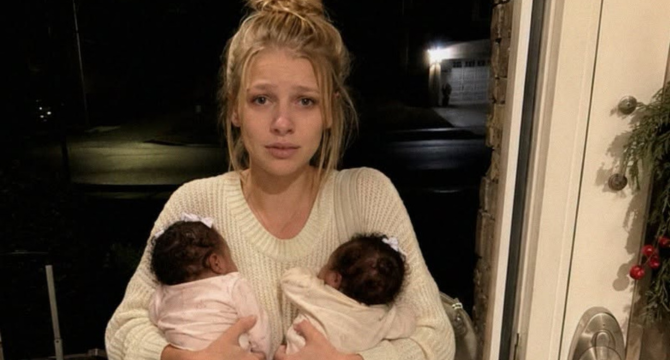
Emily stood on the porch in a thin jacket. In each arm, wrapped in mismatched blankets, was a tiny newborn baby. A rideshare was pulling away from the curb behind her, and a diaper bag sat slumped at her feet. She looked as if she hadn’t slept in a week.
“My boyfriend threw us out,” she whispered. “Please. I don’t have anywhere else to go.”I didn’t even think.
“Get inside. It’s freezing.”
I took one of the babies before I asked her name. I took the other before I asked how old they were. Three weeks old, she said. Both girls.
“Lily and Rose.”
“I don’t have anywhere else to go.”
Within days, my house was a blur of bottles, crying babies, diapers, sleepless nights, laundry, and that particular kind of exhaustion only newborns can manufacture.