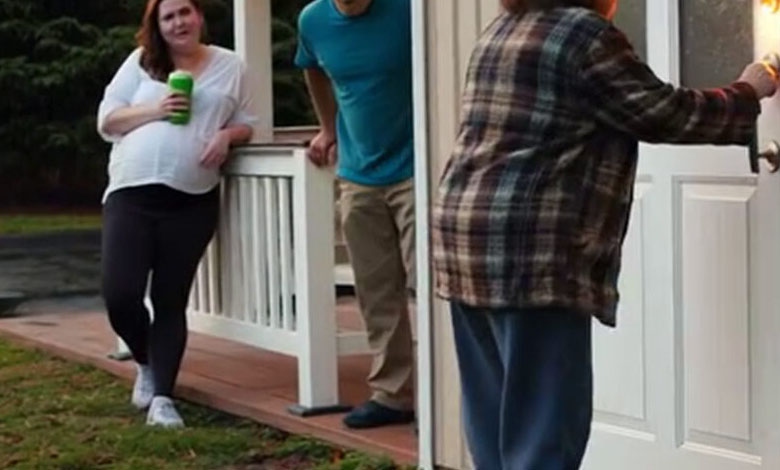
I came home to find my life’s work locked away. My daughter-in-law stood there, five months pregnant and smug, telling me my workshop was now her nursery. She thought because I was 70 years old that I was weak. She thought because I drove an old Ford truck that I was poor. She was about to find out that you never lock a master carpenter out of her own building, especially when she owns the deed to the land you’re standing on.
My name is Shirley Stone. I’m 70 years old, and I’ve spent 50 of those years building houses in the rainy suburbs of Seattle. I know every neighborhood, every zoning law, and exactly how much weight a load-bearing wall can take before it snaps. But nothing prepared me for the snap I felt inside my chest last Tuesday. I’d been gone for two weeks, driving my beat-up RV down the coast to visit my husband Robert’s grave in Portland, Oregon. It was a trip I took every year to clear my head and talk to him about the state of the world. He died two years ago from lung cancer, and sometimes the silence in our house gets so loud I can’t stand it. Driving back into Seattle, the rain was coming down in sheets, that cold gray wash that soaks right into your bones. All I wanted was to park the rig, pour a black coffee, and head out to my workshop.
That shop is my sanctuary. It’s a detached garage I built with my own hands 40 years ago. It stands separate from the main house, solid and reliable. It smells of cedar and sawdust and peace. It’s where I go when the world gets too loud. But when I pulled my truck into the driveway, my headlights caught something shiny on the workshop door. I blinked, wiping my tired eyes. It was a padlock. Not just any lock, but one of those high-tech digital ones with a glowing keypad, the kind that costs $200 and screams, “Keep out.”
I sat there in my truck, the wipers slapping back and forth, staring at that piece of metal. I’d never locked that shop. Never. My neighbors knew they could borrow a tool whenever they needed. That was the whole point: to share what you know, help where you can. I stepped out into the rain. My Redwing boots crunched on the gravel. I walked up to the door and rattled the handle. Locked tight. I felt a surge of heat rise up my neck, hotter than any furnace. I hammered my fist against the wood.
“Open up!” I yelled.
The sound was swallowed by the rain. That’s when the back door of the main house opened. Jessica, my daughter-in-law, stepped onto the porch. She was under the awning, dry and comfortable, holding one of those green smoothies she’s always drinking. Her other hand rubbed her belly, five months pregnant with my first grandchild. She uses that baby like a shield and a weapon all at once.
“Oh, you’re back early,” she said.
Her voice was casual, like we were discussing the weather, not why she’d barricaded my property. She took a sip of her drink. I pointed a shaking finger at the lock.
“What is this, Jessica? Why is there a code on my door?”
She shrugged, adjusting her expensive Lululemon cardigan.
“We changed it, Shirley. Frank and I decided it was time. That place is full of toxic dust and sharp blades. It’s a death trap. We’re turning it into the nursery.”
The nursery. My blood went cold. She was talking about my workshop. Inside those walls sat $80,000 worth of precision machinery. My Powermatic table saw that weighed 500 lb. My Festool collection that I’d spent decades acquiring. Hand planes that had belonged to my father. Those weren’t hobbies. They were my legacy. They were the tools that paid for the house she was standing in, and she was talking about them like they were garbage in a dumpster.
“Open it,” I growled. “Now.”
Jessica sighed, rolling her eyes like she was dealing with a toddler having a tantrum.
“Mom, listen to me. We hired a cleaning crew. It’s already done. We need the space for the baby. You don’t need all that junk anymore. You’re retired. Your hands shake. It’s dangerous.”
“Junk,” she called it. Forty years of mastery, junk. I started walking toward the porch, disregarding the rain soaking through my flannel shirt. That’s when my son Frank came running out. He looked pale, thinner than the last time I’d seen him. He was wearing that nervous smile he always had when he was trying to sell a bad deal in his real estate job.
“Mom. Hey, Mom. Hold on,” Frank stammered, stepping in front of his wife. “Let’s just go inside and have some tea. It’s freezing out here. We can talk about this calmly.”
I stopped and looked my son in the eye. I remembered the day he married Jessica. I’d paid off his student loans as a wedding gift, $60,000. I’d let them live in the upstairs of my house rent-free so they could save money to buy their own place. I’d given him everything I never had. And this is how he repays me, by locking me out of my own life while I’m visiting his father’s grave.
“I’m not drinking tea, Frank,” I said, my voice low and dangerous. “I’m going into my workshop. Give me the code.”
Frank looked at Jessica, his eyes pleading for permission. She just shook her head, crossing her arms over her chest.
“No, Frank. We discussed this. She’s not going in there. It’s for the safety of the family. She needs to let go of the past.”
I looked at them, really looked at them. I saw the contempt in Jessica’s eyes. She didn’t see a woman who built this estate. She saw a dusty old relic taking up space. And I saw the weakness in Frank’s spine. He wouldn’t stand up for me. He wouldn’t even stand up for himself. They thought because I was 70, I was finished. They were wrong.
I didn’t say another word. I turned my back on them and walked to the rear of my RV. The rain was coming down harder now, mixing with the rage in my veins. I opened the exterior storage compartment and pulled out my heavy-duty bolt cutters, 24 in of solid steel, the kind that doesn’t lie to you. I walked back to the workshop door, rain dripping off the brim of my baseball cap. I clamped the jaws of the cutter around the shank of their fancy digital lock.
“Mom, wait. What are you doing?” Frank yelled, panic finally rising in his voice.
He started running down the stairs. I looked over my shoulder, the muscles in my forearm, still strong from 50 years of construction work, tightened as I squeezed the handles.
“You open this door, too,” I said, my voice cutting through the rain. “You open it, and if I have to cut it, I’m not stopping at the lock. I’ll take this door off its hinges if I have to.”
Jessica screamed from the porch.
“You’re insane! That lock cost $200!”
I squeezed the handles. There was a loud pop that sounded like a gunshot. The lock snapped and fell onto the wet concrete with a metallic clang. I kicked the door open and stepped into the darkness, flipping the light switch. The overhead bulb flickered for a second before humming to life, and that’s when the real war began.
I stepped across the threshold and felt the blood drain from my face. My workshop, the sanctuary I’d built beam by beam four decades ago, was gone. I don’t mean it was messy. I don’t mean it was rearranged. I mean it was gutted, stripped bare, a hollow shell. The 800 square ft of space that had once been packed with the finest woodworking machinery money could buy was now nothing but cold gray concrete and empty drywall. The silence in the room was heavy, oppressive, like the air inside a tomb. I walked forward slowly, my boots scuffing against the floor. The sound echoed. It never used to echo. It used to be absorbed by stacks of lumber, by bags of sawdust, by the solid mass of iron and steel that anchored my life. Now there was nothing to catch the sound.
I stopped in the center of the room and looked down. There on the concrete slab were four distinct rustcolored squares. They outlined the footprint of my Powermatic table saw. That machine weighed over 500 lb. It was a cast iron beast that I’d bought in 1995. I’d saved for three years to buy that saw. It was the heart of this shop. I’d cut the timber for the addition on the main house with that saw. I’d built the crib Frank slept in with that saw. Now all that was left of it were four stains on the floor and a phantom outline in the dust.
My hands started to shake, not from age, but from a rage so pure and white-hot that I was afraid I might black out. I turned to the north wall. For 30 years, a custom-built French cleat system had hung there. It held my collection of hand tools, my Lie Nielsen block planes, my Japanese pull saws, and, most importantly, the set of Sheffield steel chisels that had belonged to my father. He’d given them to me when I started my apprenticeship at 18. They were polished to a mirror finish, their handles worn smooth by the sweat of two generations of craftsmen. The wall was bare. They’d ripped the cleats right out of the studs. The drywall was torn where they’d been careless, leaving jagged white scars against the painted wood. It wasn’t just that the tools were gone. It was the violence of their removal. It looked like the room had been stripped by locusts.
I felt a trembling start in my hands. I turned around slowly. Jessica was standing in the doorway, still holding her green smoothie like a shield. Frank was behind her, looking at his shoes. My voice was barely a whisper, but in that empty acoustic chamber, it sounded like a thunderclap.
“Where is it?” I asked. “Where is my life?”
Jessica took a sip of her drink and shrugged as if we were discussing a missing pair of socks.
“I told you, Shirley, we got rid of it. We sold it. It was just old junk collecting dust. You haven’t used half of those machines in years. We cleared it out to make room for the nursery.”
She gestured around the empty space with her free hand.
“Look at all this room. Once we put down some hardwood flooring and paint these walls a nice calming sage green, it’ll be perfect for the baby. Maybe a yoga corner for me in the back.”
I stared at her. She honestly believed what she was saying. She looked at a cabinet saw that could slice through 3-in oak like it was butter and saw a piece of scrap metal. She looked at hand tools that were worth more than her car and saw old junk.
“You sold it,” I repeated, taking a step toward them. “You sold my shop?”
“Yes,” she said, sounding annoyed that she had to explain this again. “And honestly, you should be thanking us. It was a hassle. We had to hire a guy with a truck to haul it all away, but we managed to get $5,000 for the whole lot.”
She smiled as if proud of herself.
“That’s going to cover the painting and the new crib. We’re putting the money right back into the house, so really it’s a win-win.”
Five thousand dollars. The number hung in the damp air like a death sentence. I felt like someone had punched me in the gut. Five thousand. The Festool sanders alone cost $4,000. The table saw was worth five. The jointer, the planer, the band saw, the dust collection system, the hand tools, my father’s chisels. I did the math in my head instantly, the way a contractor does when estimating a job. There was easily $80,000 worth of equipment in this room, $80,000 of assets that I’d curated, maintained, and oiled for 40 years, and she’d traded it all for $5,000 and a coat of sage green paint. It wasn’t just theft. It was an insult. It was a declaration that my life, my work, my passion was worth pennies on the dollar to them. They’d liquidated my legacy for the price of a used sedan.
I looked at Frank, my son, the boy I’d taught to hold a hammer before he could write his name. He knew. He had to know. He knew how much that equipment cost. He knew you couldn’t buy a vintage Stanley plane for five bucks at a yard sale.
“Frank,” I said. I didn’t yell. I spoke his name like a judge passing sentence. “You let her sell my shop for $5,000.”
Frank finally looked up, but his eyes skittered away from mine, fixing on a water stain on the ceiling.
“Mom, look. It’s done, okay? We needed the cash. The baby is coming. Expenses are adding up. Jessica wanted the space, and we just thought… we thought since you were gone it was a good time to transition.”
He swallowed hard.
“You’re 70, Mom. You should be relaxing, not breathing in sawdust.”
Relaxing. Transition. Corporate words. Salesman words. He was trying to sell me on my own obsolescence. I felt something crack inside my chest, something that had been holding me together for the last two years since Robert died.
“You’re telling me,” I said, my voice rising, “that you took $80,000 of industrial machinery and sold it for five grand.”
I took a step closer.
“You’re telling me you’re that stupid? Is that what you’re telling me, son? That you’re a fool?”
Jessica bristled.
“Hey, don’t talk to him like that. We got a good deal. The guy said most of that stuff was outdated anyway. No safety stops, old motors. He did us a favor taking it off our hands.”
The guy. I looked back at the empty floor. I looked at the scratches near the door where they dragged the heavy cast iron bases across the concrete. A professional rigger wouldn’t have dragged them. A professional would have used a pallet jack. Whoever took my tools didn’t care about them. They just wanted them gone fast.
And then I looked at Frank again. He was sweating. It was 50° and raining, and there was a line of sweat running down his temple. Five thousand didn’t make sense. Something was wrong.
I didn’t say another word to them. I pushed past Frank, out into the rain, and climbed into my truck. As I turned the key in the ignition, I saw Frank pull out his phone. He started typing furiously. He wasn’t calling a liquidator. He was warning someone. I backed out of the driveway, leaving them standing in the rain, and drove toward the bad part of town, toward the industrial district where the street lights were broken and the businesses had bars on the windows.
You don’t work in construction for 50 years without knowing where stolen tools end up. I checked three reputable dealers first. The men who ran those shops knew me. They shook their heads when I described my equipment. They told me they hadn’t seen anything like that come through. That’s what I expected. A legitimate dealer asks for identification. A legitimate dealer cuts a check that takes three days to clear. Frank didn’t have three days. He had desperation written all over him.
I pulled up to a place called Big Al’s Pawn and Loan. It was a concrete block building with bars on the windows and a neon sign that buzzed like an angry hornet. I’d done work on Al’s roof 10 years ago. He was a crook, but he was an honest crook. He didn’t lie about being a thief.
I pushed open the heavy steel door. A bell jingled a cheerful sound that clashed with the smell of stale cigarette smoke and old dust. The shelves were cluttered with the debris of broken dreams: musical instruments, televisions, power drills with the serial numbers filed off. I walked past a row of bicycles and stopped dead. There it was, sitting in the middle of the aisle like a thoroughbred horse in a donkey stable, my Grizzly industrial planer. It was a massive machine painted green and white. I walked up to it and ran my hand over the cast iron bed. I’d waxed that bed just before I left for my trip. It was still smooth as glass. I looked at the power cord. I’d replaced the plug cap with a heavy-duty yellow one two years ago after the original cracked. There it was, the yellow plug, and my heart hammered against my ribs.
It was one thing to suspect it. It was another thing entirely to see my machine sitting here in this graveyard of possessions.
Big Al came out from the back room wiping his hands on a rag. He squinted at me, then his eyes widened.
“Shirley Stone. I haven’t seen you in a decade. What brings a woman like you to the bottom of the barrel?”
I pointed at the planer.
“That’s mine, Al.”
Al looked at the machine, then back at me. He stopped wiping his hands.
“Yeah. I had a feeling it might be. The kid who brought it in had your nose, but he didn’t have your hands. His hands were soft, like he’d never held a hammer in his life.”
Frank. My son had dragged my planer here.
“Did he sell it to you?” I asked.
My voice was steady, but my fists were clenched at my sides. Al shook his head. He spat into a cup behind the counter.
“Nope. He didn’t sell it. He pawned it. Brought in a whole truckload of stuff. Saw, sanders, those fancy German drills you like. He unloaded it all right here on the floor. Said he needed cash, not a check.”
Cash. I felt a wave of dizziness. Pawned. That meant he intended to get it back, or at least he pretended he did.
“How much, Al?” I asked.
Al hesitated. He scratched his chin.
“Look, Shirley, client confidentiality and all that, but I like you. You fixed my roof when it was leaking buckets.”
He pulled out a ledger from under the counter.
“He took 15,000. Standard high-risk loan. 20% interest compounded monthly. If he misses a payment, I keep the tools.”
And Shirley, Al looked at me with something like pity.
“He was desperate, sweating like a pig in a butcher shop. He kept checking his phone. He told me he needed that money to save his life.”
Save his life. The words hung in the air between us.
Frank and Jessica lived like royalty. They drove leased luxury cars. They went on vacations to Cabo and drank $12 cocktails. They posted pictures on Instagram of expensive dinners and designer clothes. Why would a man living that life need $15,000 in cash from a pawn shop at 20% interest to save his life?
You don’t borrow money like that to renovate a nursery. You borrow money like that because you’re in deep, dark trouble.
I drove back toward the house as the sun was setting. The rain had stopped, leaving the streets slick and black, reflecting the street lights like oil. My mind was racing. What kind of trouble costs $15,000 immediately? Gambling, drugs, bad investments? I didn’t know, but I knew that Jessica was walking around rubbing her belly and talking about paint colors while her husband was selling his mother’s legacy to pay off a loan shark.
I turned onto my street. It was a quiet cul-de-sac lined with manicured lawns and respectable houses, the kind of place where nothing bad ever happened. I slowed down as I approached my driveway. There was a vehicle parked in front of my gate. It wasn’t Frank’s sedan, and it wasn’t Jessica’s SUV. It was a black Range Rover, sleek and menacing, with tinted windows so dark they looked like ink. The engine was idling, the low rumble of the exhaust vibrating in the night air.
I pulled my truck to the curb a few houses down and killed the lights. I watched.
The front door of my house opened. Frank stepped out onto the porch. He wasn’t wearing a jacket, even though the air was cold and damp. He looked small. His shoulders were hunched, his head down. He walked down the driveway toward the Range Rover. The driver’s side door of the rover opened. A man stepped out. He was big. He wore a leather jacket that looked too tight across the shoulders. Even from this distance, I could see the ink creeping up his neck, dark tribal tattoos that disappeared into his hairline.
Frank stopped a few feet away from him. I rolled down my window, straining to hear.
“You said you’d have it,” the man said.
His voice was a deep, gravelly baritone that carried easily in the quiet street.
“I do. I do,” Frank stammered.
His voice was high, frantic.
“I got the first installment. I just need a few more days for the rest. The bank needs to clear the check.”
The man stepped closer. He reached out and grabbed Frank by the front of his shirt, bunching the fabric in his fist. He pulled my son close, so close their noses were almost touching. Frank didn’t fight back. He went limp like a rag doll.
“We don’t do checks, Frank,” the man said. “We talked about this. Cash. You have until the end of the week, or we start taking things that you can’t buy back.”
The man shoved Frank backward. My son stumbled and fell onto the wet asphalt of the driveway. He scrambled backward, looking up at the man with terrified eyes. The tattooed man looked up at the house. He looked at the windows where Jessica was probably sleeping, dreaming of her nursery. Then he looked directly at where my truck was parked in the shadows. For a second, I thought he saw me. Then he turned, got back into the Range Rover, and peeled away. The tires screeched on the pavement.
I sat there in the darkness, gripping the steering wheel until my knuckles turned white. My son was on his knees in the driveway, weeping into his hands. He hadn’t sold my tools for a nursery. He’d sold them to pay a thug. And whatever hole he was in, $15,000 was just the down payment.
I didn’t go in there that night. Not yet. I drove to the motel out by the highway. I needed to think. I needed a plan, because if I went in there now, I’d probably say things I couldn’t take back.
But the next morning, I had to face them.
I walked into the kitchen feeling like a ghost haunting my own house. The air smelled of burnt toast and tension. Jessica was sitting at the island counter scrolling through her phone. She didn’t look up when I entered. Frank was standing by the coffee maker, his back to me. I could see the tension in his shoulders.
“Morning,” I said.
Frank jumped. He turned around, forcing a smile that looked painful.
“Morning, Mom. You were out late last night.”
“I was driving,” I said simply. “Thinking.”
Jessica finally put her phone down. She spun her stool around to face me. Her face was set in that hard, determined look she gets when she wants something.
“We need to talk, Shirley,” she said.
I poured myself a cup of coffee.
“I’m listening.”
“The contractor is coming in an hour to start framing the nursery in the garage,” she said.
“Workshop,” I corrected.
“And while he’s here,” she said, “Frank and I decided it would be efficient to make some other changes.”
She paused for dramatic effect.
“We think it’s time you move downstairs to the basement.”
I paused with the mug halfway to my mouth.
“The basement?”
“Yes,” she continued, her voice brisk and business-like. “Your bedroom on the first floor is the biggest. It has that beautiful bay window that lets in all the natural light. It’s perfect for the baby. We need that light for the nursery photos. Plus, it’s right next to our room, so it’s easier for feeding.”
My room. The room I’d shared with Robert for 40 years. The room where I’d held his hand while he took his last breath. Jessica wanted it for photos. I looked at Frank. He was studying the floor tiles intently.
“Frank,” I said, “you can’t be serious. You want your mother to sleep on concrete next to the furnace.”
And that’s when I realized something. If I wanted to find out what they were really planning, I needed to be inside. I needed access. I needed to play along. I let my shoulders slump. I let my face go slack, mimicking the tired, defeated old woman they wanted me to be.
“Okay,” I said softly.
The silence in the kitchen was deafening. Jessica stopped tapping her nails on the counter. Frank’s mouth fell open.
“What?” Jessica asked, suspicious.
“I said okay,” I repeated. “You’re right. I do cough at night. I don’t want to wake the baby. And a new TV sounds nice, Frank. My eyes aren’t what they used to be. A big screen would help.”
Jessica blinked. She looked like she’d swung a bat and hit nothing but air. She recovered quickly, though. A smug smile spread across her face.
“Well, good. I’m glad you’re finally being reasonable, Shirley. It’s about time you prioritize this family.”
“I’ll start moving my things today,” I said, “before the contractor gets here.”
“That would be best,” she said, standing up. “I want to start painting your room by the weekend. Sage green, I think, to match the yoga space.”
She breezed out of the room, victory in every step. Frank lingered for a moment. He looked at me with a mixture of relief and guilt that made him look sick.
“Thanks, Mom,” he mumbled. “It really is for the best. I promise I’ll get that TV set up tonight. I’ll run a cable line down there and everything.”
“Sure, son,” I said. “Just help me carry the bed frame.”
We spent the next two hours moving my life underground. It was humiliating, carrying my clothes, my books, my few personal treasures down those creaky wooden stairs into the gloom. The basement smelled of mildew and cold earth. The single window was a narrow slit high up on the wall, crusted with dirt, letting in a thin gray light that barely reached the floor. We set up my bed in the corner near the water heater. The pilot light hissed like a snake. Frank brought down an old rug from the hallway, tossing it over the concrete. It did nothing to stop the chill radiating up through the soles of my shoes.
“There,” Frank said, dusting his hands off.
He didn’t look me in the eye. He turned and practically ran back up the stairs.
But I didn’t sit down to cry. I waited.
I waited until I heard Jessica’s car leave the driveway. I waited until I heard Frank go into the living room to watch football. Then I moved.
I unpacked one box. Not clothes, not books. It was a box of tools I’d kept in my bedroom closet, the ones I kept close for household repairs: screwdrivers, pliers, a small pry bar. I walked softly up the basement stairs. I listened at the door. Silence in the hallway. I crept out. I went straight to Frank’s home office. It was the room at the end of the hall, the one he always kept locked. He said it was because of client confidentiality. I knew now it was because he was hiding his disaster of a life.
I tried the handle. Locked, of course.
I knelt down. The lock on this door was a simple interior privacy lock, a joke compared to the deadbolts I’d installed for a living. I pulled a thin wire tool from my pocket. It took me three seconds to pop it. I opened the door and stepped inside.
The room was a mess. Papers everywhere, takeout containers. It smelled of stale fear. I went to the desk. I wasn’t interested in the mess. I was interested in the file cabinet. I needed to find the deed. I needed to see exactly what I’d signed.
But I couldn’t do it now. Too risky. The game was on. Frank could get up for a beer any second. So I did one thing. I unlocked the mechanism from the inside so it would look like it was latched but wouldn’t actually catch. Tonight, when they were sleeping, I would come back.
I slipped back into the hallway, back down the basement stairs, back to my bed. I sat there in the cold darkness looking at the water heater. They thought they’d put me in a hole to rot. They didn’t realize they’d just given me a base of operations. I wasn’t the prisoner in the basement. I was the wolf waiting under the floorboards.
I pulled out my phone and opened my notes app. I started making a list. One: find the deed. What did I really sign? Two: track the money. Where is Frank’s debt? Three: document everything. I need proof. Four: contact Arthur. My attorney needs to know. Five: Monday, the baby shower.
That last one stuck in my mind. Monday, Jessica had mentioned it yesterday. A big baby shower. Fifty guests, all her influencer friends, a public event with witnesses. I smiled in the darkness of my basement prison. Let them have their party. Let them celebrate, because I was going to give them a show they’d never forget.