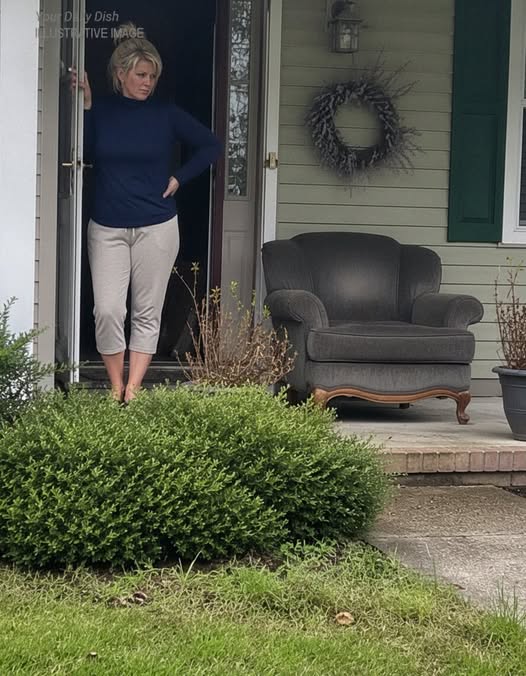
I thought my mother-in-law’s terrible birthday gift would end up at the curb. Instead, it uncovered a family secret neither of us saw coming. How could one broken armchair change everything?
Recently, my mother-in-law, Patricia, decided to “declutter” her house.
Except she wasn’t actually getting rid of anything.
She was just moving it into mine.
My husband, Ben, didn’t really care.
As long as he had somewhere to sleep, he was happy.
The first time Patricia showed up with a box of old kitchen gadgets, he shrugged and said, “Some of that might be useful.”
“Ben, there’s a melon baller in here shaped like a dolphin.”
He looked at it.
“Okay, that’s weird.”
“And this garlic press has rust on it.”
He lifted both hands.
“Mom means well.”
That became his answer for everything.
“Mom means well.”
Patricia meant well when she dropped off chipped ceramic roosters because they “added character.”
She meant well when she gave us three lamps that didn’t work.
She meant well when she brought over a box of old picture frames, most of them missing the glass.
Little by little, I watched my modern, cozy home disappear under piles of things she no longer wanted.
Random kitchen gadgets, chipped decorations, old picture frames, lamps that didn’t even work. You name it.
I tried to keep my mouth shut. I really did.
But with every new “gift” she dropped off, I felt more and more like a guest in my own home.
One Saturday, I found Patricia arranging fake grapes in a bowl on my coffee table.
“Patricia,” I said carefully, “where did those come from?”
“My storage closet.”
“Why are they here?”
“They looked lonely.”
“Fake grapes don’t get lonely.”
She smiled. “You say that because you don’t decorate warmly.”
Ben walked in, saw my face, and immediately turned around.
“Absolutely not,” I called after him.
He sighed and came back.
“Mom, maybe ask before bringing more things over.”
Patricia looked wounded.
“I’m only trying to help.”
“I know,” I said. “But help should not require a dolly.”
The final straw came the week before my birthday.
Patricia arrived in our driveway with her neighbor’s teenage son carrying one end of an old armchair.
The leather was ripped, one arm was loose, and it smelled like it had been sitting in a damp basement for years.
With a huge smile, she said it was my birthday present.
Ben and I stared at it, while the neighbor’s son stared at the ground like he wanted no legal involvement.
“Isn’t it lovely?” Patricia asked.
I opened my mouth to say something she’d remember for the rest of her life, but then my therapist’s words echoed in my mind.
She had been encouraging me to take lemons and turn them into lemonade.
So I forced the biggest fake smile of my life and said, “Thank you, Patricia!”
Patricia beamed.
“I knew you’d appreciate it.”
Behind her, Ben mouthed, “I’m sorry.”
I loaded the chair into my garage because there was no way it was entering my living room in that condition.
That night, I stood in the garage with my hands on my hips, looking at the thing.
It was ugly.
But it wasn’t hopeless.
Before I worked in marketing, I used to restore furniture for fun. I liked taking something unwanted and proving it still had life in it.
So I decided that if I was stuck with the chair, I might as well turn it into something beautiful.
Over the next few days, I repaired the frame, tightened the loose arm, replaced the padding, reupholstered it with new leather, polished the wood, and somehow managed to make it look like a designer piece.
It honestly didn’t even look like the same chair anymore.
Ben came into the garage the night I finished it and stopped dead.
“Wait,” he said. “That’s Mom’s chair?”
“Don’t insult my chair like that.”
He walked around it slowly.
“Okay, this is actually incredible.”
“Thank you.”
“Are we keeping it?” he asked.
“No.”
His face fell.
“Why not?”
“Because every time I look at it, I will remember your mother saying, ‘Happy birthday,’ while handing me furniture that smelled like a wet dog.”
“Fair.”
I listed it on Facebook Marketplace for $480.
Within a day, someone messaged me saying they wanted to buy it and planned to pick it up during my birthday party that weekend.
His name was Owen. He said he restored antique furniture and collected unusual pieces.
I thought that was perfect.
On Saturday, we had a small birthday party at the house. It was nothing fancy. Just cake, coffee, a few friends, and my sister, Laura, who arrived with wine and immediately pointed at the pile of Patricia’s “gifts” near the hallway.
“Is this a party or an estate sale?”
“Don’t tempt me,” I said while rolling my eyes.
Unfortunately, that was when Patricia showed up.
She walked straight through the open garage door with a casserole dish in her hands and spotted the chair immediately.
“Oh!” she said. “You bought yourself a new armchair? I just gave you one.”
“No,” I laughed. “It’s actually the same chair. I fixed it up. Someone’s coming to buy it later today.”
The smile disappeared from her face.
For a second, she just stared at the chair.
Then she smiled again.
“Well,” she said, “since it was my chair, I guess that money belongs to me.”
I thought she was joking, but she wasn’t.
“Excuse me?” I said.
“The $480,” she began. “That should come to me.”
“Patricia, you gave it to me.”
“As a gift.”
“Exactly.”
She lifted her chin.
“But you didn’t want it as a gift. You wanted to profit from it.”
Laura made a choking sound behind her wineglass.
Ben stepped in quickly.
“Mom, that’s not how gifts work.”
Patricia turned to him.
“Benjamin, stay out of this.”
“It’s my house too.”
“Then you should understand how unfair this is.”
I stared at her.
“Unfair?”
“You took my chair and sold it.”
“You gave me a broken chair for my birthday!”
“It was still mine.”
“No, it stopped being yours when you gave it to me.”